By
Jane Dewar
News
reports just say a 10 year old male gorilla died Thursday, May 17th, as a
result of wounds from a fight with a dominant, older gorilla two weeks
earlier. An
impersonal story of a generic gorilla to most, this one hits particularly
close to my heart, since the death was of one of my “babies” – a gorilla
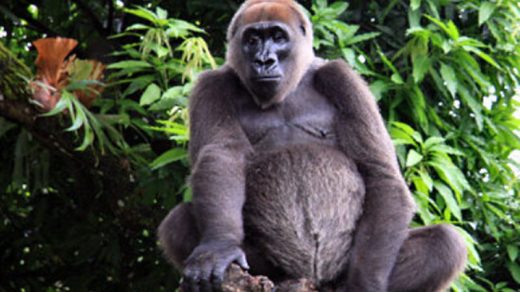
I watched from birth and hoped to follow his life through to maturity. (Photo
left of Chuma at Disney's Animal Kingdom, May 2000, thanks to Lisa Simmons).
June
28, 1991 one of my first gorilla “friends” – a female named Alpha –
gave birth to her first son by another one of my first gorilla “friends,”
Ndume. Ndume had been giving the staff at Brookfield Zoo
problems, since he was/is an extremely intelligent and sensitive animal and
was stressed by the exhibit in which he and his family were living, which had
human visitors standing over them most of the day, yelling or taunting them.
In the wild, you’re taught to crouch to be lower or at least eye level with
a gorilla, since standing is a sign of disrespect or even a threat.
How or why Brookfield’s Tropic
World was designed to have parades of humans looming over the gorillas
mystifies me, and while some gorillas learned to live in such conditions,
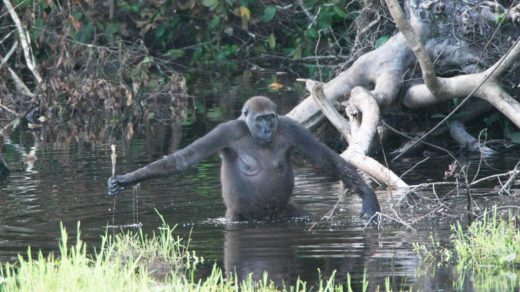
Ndume never could. (Photo above, right, taken February 1991 by our friends Jan
and Tom Parkes). Instead, he learned a clever way to get the more
annoying people to move on – he’d pick up bits of poop or food and throw
it at them – with remarkable aim and accuracy. In the 4 years I knew
Ndume, he never threw anything at me, however, seeming to recognize me as a
friend. I, in turn, would approach loud, obnoxious zoo visitors and
engage them in conversation to get them to stop their inappropriate behaviors
and Ndume seemed to appreciate this and understand I was trying to help.
But one day Ndume threw
unmentionables at the zoo director one time too many and he was suddenly
deemed unsuitable, genetically redundant and sent back to his home zoo of
Cincinnati, where there was no room for him. Eventually, Ndume went to
live with Koko, the signing gorilla – to have a baby with her, according to
the press releases at the time, although he was deemed genetically redundant
at Brookfield, so this didn’t make sense to any of us who knew what was
really going on. So when Mtu Chuma was born, he never got to see or know
his father, like his older sister, Baraka did. And that was one of the
tragedies of his young life.
But Chuma’s mother,
Alpha,
was/is an experienced mom, with wise eyes and a sometimes down-right silly
manner. She adored Ndume and when he was sent away, I think she decided
her son, Chuma was going to have to take his place, as she bestowed on Chuma
maternal love, playfulness and affection second to none. When I first
met Alpha, she had rejected her earlier son, Kwisha ( born in 1988 and now at Toledo Zoo), who
was raised by humans and then adopted by his older sister, Babs.
Initially I thought Alpha was an awful gorilla and bad mother – but then I
soon realized, she had just been mourning the loss of her son’s father, the
magnificent silverback Samson, who had died just before Kwisha was born.
She was depressed. And so little Kwisha didn’t have the maternal
attention and devotion that Chuma was showered with, although he did grow up
in a tight-knit family group with his siblings.
Once again, Alpha had a son with
no father. When Chuma was around 4 days old, I visited Brookfield to see
the new baby, taking my video camera to record the event. I got to my
usual spot and below me sat Alpha, cradling her tiny bundle and keeping him
away from prying eyes of the public and the other gorillas, who were keen to
see their newest family member. The docents and visitors were all
complaining how uncooperative Alpha was being, since they hadn’t been able
to get a good look at the baby, and I remember thinking “Well, she’s doing
her job then – she’s not here for your enjoyment, she’s here to protect
her baby!” As I always did during my regular weekly visits, I nodded
my respectful greeting to Alpha, who looked up at me with her droopy
Alpha-eyes and then I smiled and nodded, thinking how happy I was to see her
doing such a good job with this baby, even though I was saddened to know the
baby would never know what a wonderful father he had.
Suddenly, Alpha turned, opened
her arms to expose the baby to me and my camera, held him there a few seconds,
looked up at me as if to say “you satisfied?” and then resumed cradling
him defensively once again – very similar to the experience I had with Tebe
(see Tebes Miracle). I can’t
“prove” this was deliberate or that Alpha meant to show me her baby, but
anyone who knows gorillas know they recognize individuals and they like and
dislike individuals too. I saw Alpha in May 2000 and while she’s
showing her age (40 years old), she remains one of the most influential
gorillas of my life. She won’t know her son is now dead and the world
won’t know what might have been, had Chuma lived.
One
of the last times I remember seeing Chuma at Brookfield, he was almost as big
as his mother, and about 5 years old and still nursing (they usually stop
around 3 or 4 years old), which made me laugh out loud to see. Alpha
just calmly tolerated his insistence and when he was sated, Chuma would go
play tag with his sister, Baraka or the others in his group, without a care in
the world. Watching him strut around like a mini silverback one minute,
then revert to being a big baby suckling at his mother’s breast the next,
was a sight I will never forget.
Shortly thereafter, Chuma was
moved out and joined the all male group at Disney’s Animal Kingdom (AK).
The last time I saw Chuma was September 2000. I was floored to see how
big he was and how much he resembled his mother. No one at AK
could/would tell me who was who since they don’t use names for their
gorillas (see What's in a Name?), but I could figure
out who was who by a process of elimination, since I knew all the boys in the
all male group, even though they had all grown up so big so fast.
This is a tragedy that must be learned from and avoided in the future. Gus, the dominant silverback (see Silverback Award) was merely defending his position as the "alpha" or leader of the group and surely didn't intend to do Chuma permanent harm. In the wild, Chuma would have challenged Gus's authority and if he lost a fight with him, he would have moved on, to live by himself or perhaps with 1 or 2 other males, until he could find females to form a group of his own. But Chuma had no place else to go. While I know of a couple of other gorilla deaths during introductions (usually heart attacks caused by the stress of the introduction themselves, not any physical wounding), this is the only gorilla death I know resulting in wounds from a fight like this. No one - human or gorilla - is to blame. There’s still so much to be learned about gorillas and hopefully Gorilla Haven will be able to assist the zoo world in figuring out how to improve husbandry techniques and tactics, to improve the lives of each and every captive gorilla.
Rest in peace, Chuma. Your sister, Baraka, just made history having the first baby of the gorilla Ramar at Brookfield. Your half brother, Zuza, is growing in leaps and bounds at Pittsburgh. Your mother and father and countless relatives live on and I know I'm not the only human who will keep you in my heart, privileged to have known you.