Your/Our Donations Making a Difference!

By Jane Dewar, 01 September 2002

Gorilla Haven is a multi-faceted project.  The GH facility in the mountains of North Georgia is geared towards helping a certain number of Western lowland gorillas in captivity. However, it makes no sense to focus only on captive gorillas, when their wild cousins in Africa are facing extinction as you read this message, so our mission is more far reaching than many may realize.  One aspect of donations to GH is that 100% of it can and does go directly towards helping animals and people in conservation.  The GH facility is privately funded by Steuart and I personally, enabling us the rare privilege of being able to direct 100% of any unsolicited funds directly to people and projects where we know the people involved and believe we'll maximize the investment in helping various projects.   When the devastation of the war in the Congo first reached us, I asked Steuart what the maximum amount of money was that we could give to help my dear friend, Jo Thompson, in her efforts to protect her own bonobo research site and its environs.  Then I asked if we could double that amount and he agreed, since the planet's only Eastern Lowland gorillas (Gorilla Gorilla Graueri) are only found in The Congo.   Knowing Jo was a rare and feisty lady who, like me, shared a passion for her animals and the people she works with, I sent the check, hoping against hope it wasn't in vain.  Jo kept us appraised with how our money and that of several other wonderful conservation organizations and individuals sent as well was spent.  Since the Crisis Fund was just that - money to help get through a crisis - we're happy and proud to add Jo's update showing how one person CAN make a difference.

Below is a report written by Dr. Jo Thompson, Director of the Lukuru Wildlife Research Project documenting the progress and success in reaching some important, immediate goals. You can also read some of the background history on the crisis in the Congo.

Some Good News from The Congo*- Update20 August 2002 by Dr. Jo Thompson

*DRC = Democratic Republic of the Congo

This past year has seen the DRC Parks Relief Mission reach its goal and more. In October 1999 I stated our goal as an immediate, short-term, "bottom-up" emergency relief effort to provide emergency survival and morale supplies directly to the DRC Park Rangers, which we could reach during the war.” We clearly defined our exit strategy and we have successfully reached it. We have completed our goal by securely delivering materials to Kahuzi-Biega (PNKB), Upemba, Kundelungu, and Salonga National Parks, as well as manufacturing uniforms for all DRC Parks Gardes and producing the new Garde de Parc insignia patches for 1,600 personnel across the whole of the country. Our efforts and communications have also inspired an American NGO to begin working in Maiko National Park, the first efforts on-the-ground in a decade. You will remember that 100 percent of the Grauer’s Gorilla population occurs in DRC, half of the entire population are found in the Kahuzi-Biega and Maiko National Parks. So, these efforts are critical to the survival of this magnificent gorilla type. The PNKB Garde de Parc continue to monitor the gorilla population and still have not lost any since January 2000. Conservation successes continue!

Through the Gorilla Haven response and website, the Lukuru Wildlife Research Project facilitated support either financially or with in-kind services from 40 organizations and many more individuals from the global conservation community in nine countries on five continents. Gorilla Haven was one of the first to step forward … and they have extended support throughout the life of the DRC Parks Relief Mission.
Your direct contributions have enabled us to provide materials that respond to the emotional and physical needs of the Park Rangers (including things specific to individual parks) and aide them in monitoring, patrolling, and protecting their critical wildlife and habitats. They now know that their efforts are extremely important, that the international community cares and is providing concrete support on their behalf. Today the Congolese authorities have actively renewed their commitment to conservation. Large international conservation organizations and funding sources have now begun to reach the DRC. We have been contacted by several international organizations for advice about establishing disaster relief committees or emergency accounts to fund rapid actions in the future.
Our emergency resources and motivational support included: personal items (woman’s clothe pagne’s; 1,300 lbs of mixed clothing for men, women, and children; donated Zoo keeper uniforms; 100-lb bale of socks; pairs of flip flop sandals; and blankets), household goods (sacks of rock salt; large serving spoons; table knives; cups; bowls; buckets; matches; razor blades; lock & key sets; mosquito netting for beds; spools of thread; safety pins; sachets of 10 litre bidons; powdered milk; sugar; and cartons of soap), basic medicines (Amodiaquine Malaridose Zenufa – a relatively new malaria cure treatment 3-pill protocol; Chloramphenicd Collyre pink-eye drops; Amoxycillin capsules; Multivit multivitamins tablets; Paracetamol tablets; Fortified Procaine Penicillin - Injectible Benzyl penicilliin vials; Sachets of Oral Rehydrations Salts; Quinine Sulfate; Aspirin tablets; Indomethac Indocide muscle relaxant; Mebendazole tablets worm cure medicine; Metronidazole anti-helminthic and antiamebic; Erythromycine; cotton balls; syringes; sterile precision-glide needles; winged infusion sets; alcohol preps; sterile IV sets; sodium chloride drip bags; and Liquid cough suppressant for children), anti-poaching equipment and development tools (rubber boots; Coleman Nevada 2-person tents; Lafuma rain ponchos; Bergamo backpacks; 24” and 16” machetes; shovels; hoes to clear patrol routes; canteens; GPS units; 100 2-meter-sized industrial sacks to transport cash crops to market; salaries to the park personnel; a color printer; a scanner; computer software; construction materials to repair Ranger houses and administrative structures; a hydroelectric plant generator; and bicycles), communications equipment (40 Motorola walkie-talkies with rechargeable batteries and regular backup batteries; and new VHF radiophoniques with accessories including antenna, cables, 12V battery, solar panels), wildlife conservation education materials (posters; pencils; stickers; special cahiers and depliants; magazines; brochures; and tee shirts), administrative supplies and equipment (manual typewriters with spare ribbons; bics; reams of paper; and boxes of envelopes), and school supplies (construction paper; pencils; bics; blackboards; chalk; school books and materials; museum donated scientific literature; scissors; glue; posters; water color paints; paint brushes; cahiers; toys; and soccer balls).
In addition to these ventures, five issues of ‘Le Gorille – Parc Nationale de Kahuzi-Biega’ have been printed and distributed to the communal human population in and around PNKB. We have involved the United Nations in issues of environment and wildlife conservation. Our efforts supported the first survey of PNKB (conducted in June 2000 by ICCN and Wildlife Conservation Society) by providing important research equipment. In producing the Parc de Garde uniforms, 80 percent of the funds were spent in Kinshasa demonstrating the ideal union between conservation and economic development.
The DRC Parks Relief Mission has achieved a tangible and meaningful conservation effort. We have witnessed park guards who have regained their identity, motivation, unity, and self-esteem. You and Gorilla Haven have made a difference! Thank you!
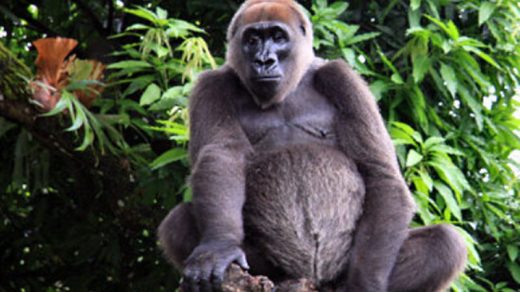
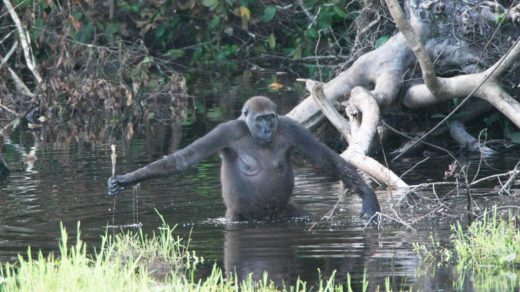
Photos: Above left of Eastern Lowland MUKISI from an old postcard of him while at Chester Zoo in England (I believe), sent by Stuart Nixon. Above right of Eastern Lowland AMAHORO, reclining at her current home in Antwerp Zoo in Belgium (photo courtesy of Jeroen Stevens).