Some Fun Info and Facts About Gorillas
for Kids
Big and Small!

What is a primate?

The dictionary says primates are the "highest" form of mammals, but since elephants, dolphins and whales (and even gray parrots!) are pretty smart and advanced too, we’d like to find another definition for a primate.  Can you help? Here’s what we know:

There are over 230 primate species!  Primates are:

Great Apes include:

Three of the four species of Great Apes live in Africa. What’s the other one and where do they live?

It’s the Orangutan, and they live in Asia, specifically Borneo and Sumatra

Lesser (now referred to as "Smaller" ) Apes are primates too. What are the best known Smaller Apes?

Gibbons and Siamangs. Gibbons are also from Asia.

What’s one of the main differences between apes and monkeys?

Monkeys have tails; apes do not.

There are three sub-species of gorillas:

  1. Western Lowland Gorillas (gorilla gorilla gorilla). These are the kinds you see in zoos today. They are the smallest of the sub-species with short blackish hair (sometimes reddish brown on the head) and live mainly in forested areas of the Central African Republic, the Congo, Cameroon and Gabon, Equatorial Guinea and Nigeria.
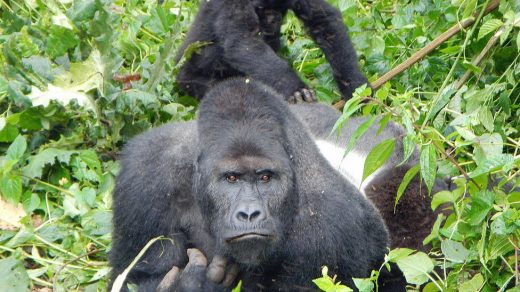
  2. Eastern Lowland Gorillas (gorilla gorilla graueri). There are currently 4 Eastern Lowland gorillas in captivity; three at the zoo in Antwerp, Belgium, and one in Houston, TX. The have a narrower face and broader chest than the western lowland gorillas and shorter hair like their western cousins, but they are slightly larger. They live mostly in eastern Zaire.
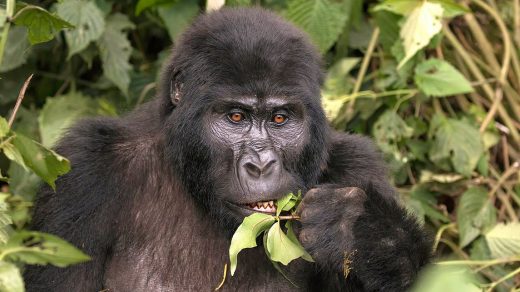
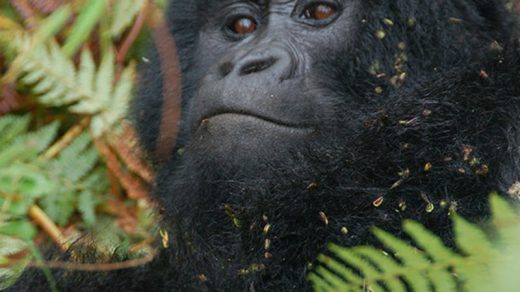
  3. Mountain Gorillas (gorilla gorilla beringei). There are NO mountain gorillas in captivity today. These are the largest, gorillas with the longest hair (to keep them warm in their cooler mountainous habitat!). These are also the rarest gorillas, which Dian Fossey and many other scientists studied in Rwanda; they also live in Uganda and eastern Zaire.

Can you fill in the blanks with the proper sub-species of gorilla?

Eastern Lowland, Western Lowland, Mountain. These numbers are rough estimates and may have changed.

Flash!! May 2000 - at the Brookfield Zoo Ape Conference, the following information was presented. Scientists are still discussing the merits of this re-classification based on new evidence.

Species #1:  Eastern Gorillas:  What used to be called “Mountain Gorillas”

a)  subspecies: gorilla beringei beringei found in the Virungas, Uganda and Democratic Republic of Congo.  NONE in captivity.  These are the gorillas Dian Fossey studied and who were featured in the movies and her book entitled “Gorillas in the Mist”   Probably only about 300 of these remain.

b)  subspecies:  gorilla beringei bwindi (suggested name, not official) – found in Uganda’s Bwindi Impenetrable Forest.  Probably only about 300 of these remain.

c)  subspecies: gorilla beringei graueri  subspecies: gorilla beringei graueri – formerly known as “eastern lowland gorillas” and now seriously imperiled due to the Crisis in the Congo.  There are only 4 in captivity – 3 in Antwerp, Belgium and 1 in Houston, Texas.  No one is sure how many of this subspecies remain, due to the current war in their home, but numbers are plummeting fast, and are probably now well under their last estimate of 5,000.

 Species #2:  Western Gorillas:  What used to be called “Lowland Gorillas”

a)   subspecies:  gorilla gorilla gorilla Found in Western and Central Africa, like Cameroon, Gabon, Equatorial Guinea and Nigeria.  These are the kinds found in zoos. No one seems to know how many of these exist, but the best guess is about 10,000, plus about 750 in captivity.

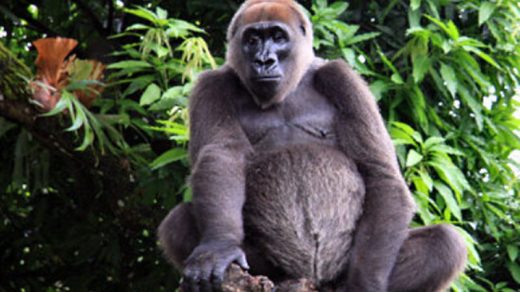
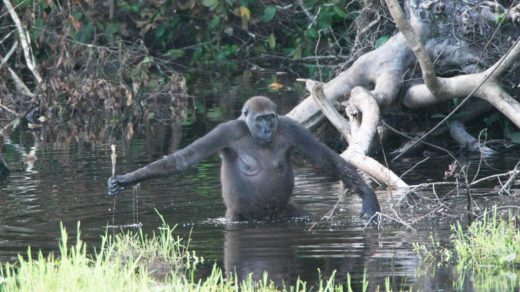
b)   subspecies:  gorilla gorilla diehli – The most endangered gorilla – indeed primate – on the planet, known as the Cross River gorilla, found only in a tiny part of northern Nigeria.  Limbe Wildlife Center’s oldest gorilla, Nyango, has been confirmed as a Cross River gorilla, through DNA tests.  Only about 100-150 are thought to exist in the wild.

Some Gorilla Facts and Factoids:


Do Gorillas Really Talk to Humans and Each Other?

Scientists are still debating whether or not other animals use real "language" but there is no doubt that gorillas and most every animal has their own unique way of communicating with each other and the world around them. When Jane met Koko in 1989, she taught herself some ASL (American Sign Language), so Koko wouldn’t think she was stupid! Jane signed "I love gorillas" and Koko replied "Love gorillas YOU!" which we video-taped so we could see it was really very clear exactly what Koko signed.

In zoos and in the wild, gorillas communicate with each other using various sounds, which are soft grunts, purrs, rumbles, coughs, bark and grumbles and chestbeats. Unlike chimpanzees, who can be very noisy, gorillas are very quiet animals.


What’s your Gorilla IQ?

True or False?

IQ Test Answers: