|
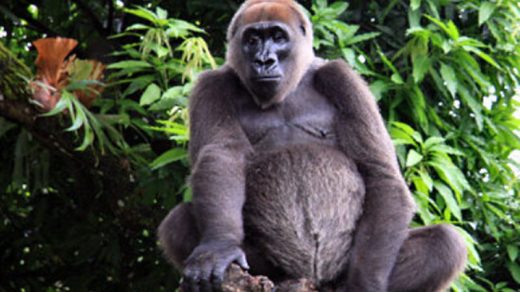
Batek before arriving at Limbe |
My name is Batek. I am a boy, western lowland Gorilla, I was born near Batouri in the Eastern Province of Cameroon in the middle of the rain forest. When I was two years old, my mother and our family were quietly eating in the forest when something scared us. My father, the silverback, tried to protect us, but he and the others were out-numbered by the hunters with their long, metal sticks which shot out pain and death. So the other family members ran away. My mother started screaming, and a hunter shot her with a gun and wounded me on my arm. We were both bleeding. When my mother stopped screaming and fell to the ground the hunter came and took both of us. This was in June 2001. My mother was killed for bushmeat, but since I was so little, the hunter let me live. A reverend sister nurse rescued me from the hunters and took two months to nurse me back to health. In August 2001 she took me to the home of a Bishop in Batouri. Lots of good food was given to me. The bishop and other reverend sisters were very nice to me and built me a cage. |
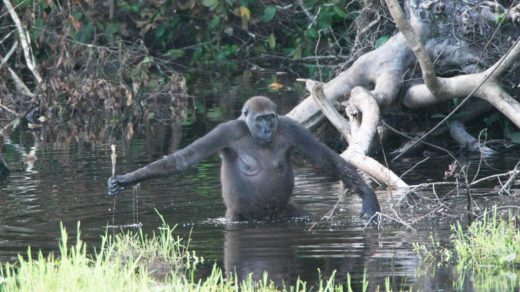
Batek after arrival at Limbe
|
|
In January 2002 a lady named Selma visited the Sisters and saw me. The Bishop told her he wanted hunters to find me a playmate, but Selma knew that would mean more gorillas would be killed, so she pleaded with him to let me go live with other gorillas. Selma did a lot of research and decided Limbe Wildlife Centre was the best place for me.
So they came to get me in a big noisy metal bird and flew me to Limbe.
I was happy to be able to climb trees and play in grass again. I have to wait to meet the other gorillas as they keep me in a place called "Quarantine" but already I know I'm home with other gorillas and a loving human family to help me grow. P.S. One day while his keepers were taking Batek on a tour of the LWC, Batek spied the other gorillas and even though he had not met them yet, ran over to greet them (photo right). Photo Credits: photos left by Selma Forotti. Remaining four photos right courtesy of LWC |
|
|
Akiba's story - Akiba arrived at Limbe in July of 2001. While her previous history is unknown it's clear she was a victim of the bushmeat trade. Today she is happily esconced in the family group at Limbe where Pitchou and the others have warmly accepted her.
Photo Credits, left to right: 1st three photos by David Lucas, including Nyango carrying Akiba. Far right photo by Tony Chassar shows Pitchou in background watching over Akiba.
May/June 2001: As mentioned in the 24Jun01 News Update “Summer of Changes”, I spent almost a month in Cameroon, the primary goal of which was to see how the LWC was doing since my last visit two years earlier. There were many changes and a lot of improvements, too numerous to mention here, but it was clear that the money we donated and helped raise was making a wonderful difference in the lives of the humans and animals alike. Steuart needed to see firsthand just how his hard-earned money was being put to good use, so he came with me and was duly impressed by the enthusiasm and efforts of the Cameroonian staff. His time was limited, since he had to return to GH to supervise construction, but I spent an extra two weeks, visiting the LWC daily from 9 a.m. until 6 p.m. with no breaks and loving every minute of it!
The biggest change for me was the absence of gorilla Evindi, the Romeo of gorillas mentioned in my first report. Evindi had succumbed to a mysterious illness – perhaps meningitis – about six weeks before I visited, and many of the zoo’s animals and humans were fighting high fevers and mysterious ailments. While most recovered, Mr. Joseph Abang, LWC’s longest employee, died shortly after Evindi – a huge loss to the staff, since he’d been at the LWC for 19 years – longer than anyone else. Mr. Abang’s son, Felix, is now working at Limbe continuing his father’s dream of seeing Limbe become a world-class conservation center. Many of my old friends were still there, and new keepers had joined the staff, which remains one of the best I’ve seen. Gorilla keepers Wilson, Jonathan and Bama were still there, although Wilson had been moved to Education Officer – an important job he is excelling in and Jonathan’s duties include helping with the chimpanzees now too. Bama still lives for “his” gorillas, who all adore him too.
Nyango,
“The Queen” looked the same, but she was far friendlier this time
around. Perhaps my daily treats
and parties were a factor, but even Bama admitted he was surprised to see
how friendly she was towards me, including stroking my face and hair gently when I’d give her her evening milk, as she and Chella
settled into their night quarters. Nyango’s
DNA has been tested and she’s definitely a Cross River gorilla
– one of
the newest sub-species to be identified for gorillas (gorilla gorilla diehli)
and the only confirmed one in captivity.
With less than 250 estimated to be still in the wild, Nyango, like
her eastern lowland (gorilla gorilla graueri) cousins, may be the last of
her kind on this planet – a thought than makes my heart sink with sadness.
Her right eye seems definitely blind now – the result of a wound
inflicted by a zoo visitor years ago when Nyango was the only gorilla there
and she would run around with her keepers, not being confined to a cage or
enclosure. This visit she was
down-right silly, playful and as happy as any gorilla I remember seeing,
purring and singing when she got treats, sounding like someone humming a
high-pitched, off-key tune. She
was showing signs of maturing sexually too – at 11 years old, she’s more
than ready to breed – but so far her attempts at getting Chella to do the
right thing have failed, as the two spend most of their times play wrestling
and chasing each other.
Pitchou
“The Princess” and Star of Limbe was the most changed – she was huge!
Her face and demeanor hadn’t changed, but she was as large (if not
larger) than Benito and Emma, who are older than her by a year or so.
Pitchou would cough (a sign of aggression or warning in “gorilla”
language) whenever treats were being handed out, warning the others to stay
away to be sure she got her fair share.
She would play with each of the 5 other gorillas in the sweetest
one-on-one play bouts, but the funniest and most surprising thing for me was
watching Pitchou while Nyango and Chella were rough-housing.
Pitchou would follow the two older/bigger gorillas and whenever they
got too cozy, she’d jump in between them, very much like young gorillas do
when they try to stop adult gorillas from having
se
x.
But besides this running of interference between Nyango and Chella,
Pitchou was bottom-slapping! This
is something some gorillas do as part of their sexual behaviors, often
directed at humans or another gorilla.
At first I didn’t believe I was seeing it right, but it happened so
often and my video tape confirmed there was no doubt our baby Pitchou was
already vying for Chella’s affections!
Again, Mr. Goofy a.k.a. Chella doesn’t seem to know what’s
expected of him … yet. Time
will tell.
Chella,
“The Robin Williams of Gorillas” or my Bella, had grown like most young
teenaged boys do – from little boy to skinny young man, although he’s
only about 9 years old now. His
droopy eyes and goofy demeanor hadn’t changed, but his confidence that one
day he’d be the boss had matured. When
Bama went in to clean the enclosure and turned off the hot wires, I’d
stick my hand inside with my palm upwards and say to Chella “Give
me five!” … Not realizing the hotwire wasn’t turned off, he’d
hesitantly approach me and quickly and lightly smack my hand with his fist,
until he was sure touching my hand wouldn’t give him a shock. Once he was sure that was the case, he’d repeatedly slap my
hand with all
his might and I could hear him chuckling as he did it,
thinking the clapping sound our two hands made was the funniest noise he’d
ever heard! Another time I was
chewing bubble gum and he was fascinated, so I leaned in and blew a bubble
from my side of the hotwire (which was on!).
He stared spellbound and then suddenly, with great dexterity he stuck
his index finger in between the hot wire and popped the bubble, garnering a
miniscule bit of gum in the process, which he stretched and treasured
forever afterwards, as the other gorillas tried to steal the speck away from
him. I swear some days when I left the zoo my cheeks were sore
from laughing or smiling at him and the other gorillas so much!
Jumbo
“The Little Mermaid” is my vote for the leader of the group one
day, since she’s one of the brightest gorillas I’ve met.
She took on Evindi’s old role of following me everywhere, and
making sure I was her best friend at all times, but especially when treats
were being handed out. She’d
surprise and amaze me by reaching up and grabbing food out of Nyango and
Chella’s mouths, so quickly they didn’t realize what had happened!
Most of my photographs have Jumbo in them, since she was my shadow.
One day the trousers I wore started to rip along the seams – they
were cheap and so I was going to just throw them away instead of trying to
sew them up. But then I thought I’d bring them the next day (after washing
them in my hotel room sink) and toss them in for the gorillas to play with.
Bama and I watched hysterically as Jumbo fought Nyango and Chella for
them, and soon the trousers were in several pieces and each of the six
gorillas had a piece, which they carried
around for days, like Linus and his
blanket. Naturally, Jumbo took
her piece and dunked it in the pool or brought it to the water tap to soak
it, scrubbing around her or washing her hair with the wet rag (see photo
left).
One day the children and I gathered the discarded pieces of cloth
(photo right), washed them, then
smeared peanut butter and cookie crumbs on one side, and tied the pieces
into knots, before tossing them back in for the gorillas as treats.
I’d made 7 treats, figuring Chella, who was pretty skinny and could
have used the extra calories being the growing boy he was could have 2
treats, but Jumbo had other ideas and ended up with two!
Emma
“Miss Demure” looked the same and when Steuart first saw her standing
upright, he laughed and said she looked like she was doing a caricature of
herself, since he’d seen so many photos of her standing bipedally from my
last visit. But Emma was no
longer the quiet, shy, introverted little girl I remembered.
She would rough-house and play with everyone else, but her favorite
playmate was Pitchou and the two of them would stroll around the enclosure
in tandem, litera
lly hanging onto each other like best
buddies (photo right: Emma/Pitchou).
While Nyango continued her habit of charging around and smashing the
mesh as part of displays of annoyance, I was surprised to see Emma doing the
same thing – only she wasn’t angry, she was just showing off and having
fun! While Emma and Nyango had
discovered R&R (regurgitation and reingestion, a stereotypical behavior
not uncommon in captive gorillas, but not seen in the wild), Emma no longer
sat alone, sucking on her arm or rocking and she seemed much more confident
as an important part of the group.
Benito,
or “Gary Cooper of Gorillas” was still a shy, introspective little
gorilla, but he’d also spend a lot of time challenging Chella, who dwarfed
him but still played gently like a great big brother would play with his kid
brother. Benito would alternate
between being a strutting mini-silverback playing with Chella to being a
crying little baby gorilla, pouting and whimpering whenever I left the
gorilla enclosure to visit the chimpanzees or other animals at the zoo (see
photo on the left).
One night after I gave everyone their evening milk, Benito was crying
so loud, I had to return to tell him it would be ok. He was reassured and I was able to leave, but it occurred to
me night time needed to be something more than the end of a fun day with
Auntie Jane and all my treats and fun games.
So Bama enthusiastically took on the challenge of making their night
quarters something to look forward to, cutting down fresh elephant grass,
banana leaves, wild ginger, etc. and filling the night rooms with them
sprinkled with ground nuts, special treats (cereal, fruit, favorite
vegetables, etc) in addition to their evening meal.
Benito would still whimper if I left him during the day, but at
night, he’d be too busy finding all sorts of treats Bama and I would hide
for them.
![]()
This
visit I also took the time to make a point of learning the names of the
other animals at the LWC too, including the baboons, mandrills, drills
(photo left),
chimpanzees and monkeys (photo right). With
over 80 animals, that’s a lot of names, but I think I got most of them
down, and even though I still confuse a mona monkey with a preuss guenon at
least now I can tell a red capped mangebey from an agile mangabey and know
the difference between a spot nose and a putty nose monkey!
There were more chimpanzees there this time – 26 versus the 19 that
were there in 1999. I think I
knew at least 20 of them by sight instantly, with another 4 who I could tell
who was who if they were side by side and another 2 who constantly confused
me. The only animals I
couldn’t identify individually were the drills – with 13 of them in
their newly expanded, lush enclosure, I could only tell Tommy from Tarzan
and everyone else looked the same to me (ok, except Koko and Jest, the
youngsters, who were like Twiddle Dee and Twiddle Dum, doing everything
together and bouncing off the walls!).
But I decided to leave that for another visit.
The
chimpanzees were also enjoying their newly expanded enclosure, which was
being built in 1999. It was
great seeing them running, climbing and playing together. Photo
left shows Loko with newcomer
Jackson. The mandrills just got a larger enclosure too, as the 3 of them now
have access to the drill’s old enclosure, modified for their use.
The baboons will soon have a lovely, lush and large enclosure (we
brought over some of the fencing supplies to finish this, thanks
to excess luggage allowance granted by Air France!), and the next step
is re-doing and expanding the monkey cages, since overcrowding is causing
fights and injuries. But the
biggest challenge the LWC will face will be the growing gorillas, who could
easily smash their way out of their current night quarters if they ever
figured out how flimsy the building really is.
Plans are in the offing for expanding the gorilla enclosure and
fortifying the night quarters and it can’t be done too soon.
Thankfully, the personalities of the gorillas are such that they’re
pretty easy-going, but changing hormones and testosterone could well change
that sooner rather than later!
All photos by Jane Dewar (or with Bama's help!).
Update to My Update: I’d written the previous report in late June, waiting for Steuart to have time to add it with photos to our website. By the beginning of July, I learned that the Yaoundé Zoo was getting 2 baby gorillas, including a 3 week old, and Limbe was getting one baby gorilla, reinforcing the fact that the bushmeat trade is alive and well in West/Central Africa, even if that means its victims are not …Now, more than ever, we need to let our voices heard... Click here for the story.