By Jane Dewar, 15 February 2000
See Latest Update (21-mar-2001) Below! Gorilla Haven is geared towards helping a certain number of Western lowland gorillas in captivity. However, it makes no sense to focus only on captive gorillas, when their wild cousins in Africa are facing extinction as you read this message, so our mission is more far reaching than many may realize. GH recently donated funds to help the current crisis in the Congo and wants to make our readers and supporters aware of the tragedy unfolding. Below is a report written by Dr. Jo Thompson, Director of the Lukuru Wildlife Research Project.
If we do nothing, the slaughter will go unchecked and gorillas and unique ecosystems will be lost forever. Write your Congressmen or local newspapers and media to ask why you're not hearing more about the Crisis in the Congo. The world stood by as the genocide in Rwanda in the early 1990's unfolded. To stand silent again is unthinkable. Precious human, animal, plant lives are at stake.
| If, after reading
about the problem, you want to help re-provision the
wildlife park guards and help the local people trying to
protect their wildlife heritage, send your checks
to Gorilla Haven, P. O. Box 210, Morganton, GA 30560, USA. We will in turn forward 100%
of your funds to the Friends of Lukuru Fund which is
already sending supplies into the Congo. Our goal of
helping a small number of western lowland gorillas in
captivity will be rendered pointless, if we do nothing.
Photo right by Lisa Simmons. This is Mac (M'kubwa) at the Houston Zoo - the only Eastern Lowland Gorilla in North America and also at 47, the oldest living male zoo gorilla. There are only three other Easterns in captivity, housed at the Antwerp Zoo in Belgium. |
|
Crisis in the Congo - by Dr. Jo Thompson
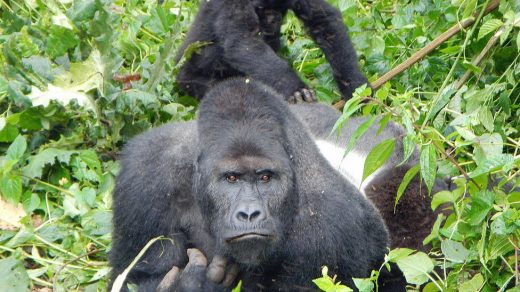
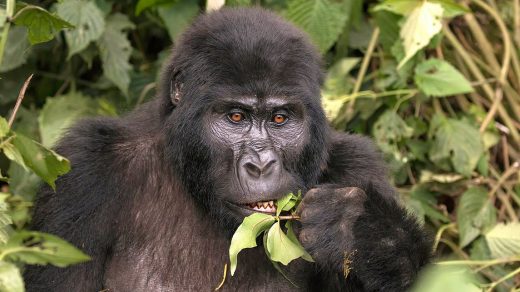
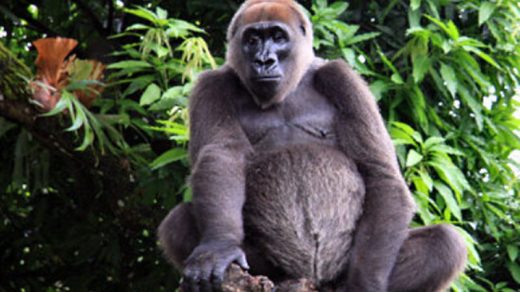
The Eastern lowland gorilla (Gorilla gorilla graueri) is found only in Eastern Democratic Republic of Congo (DRC, formerly Zaire). In 1998 there were an estimated 16,900 of this precious subspecies. In the past year those numbers have crashed. Half of the declining world population are found in two National Parks. Both the Kahuzi-Biega and Maiko National Parks provide homes for populations of Grauer's gorillas. Riddled with a legacy of unrest, war erupted within the borders of DRC in August 1998. Details and information were nonexistent or, at best, meager and isolated for nearly a year.
Then in July 1999, reports began to emerge which described the widespread annihilation of wildlife across the DRC. These horrific reports were coming out of those sanctuaries designated by the national government as National Parks. We soon learned that organized poaching to supply a growing commercial-scale trade in bush meat is largely being supplied from the DRC Parks network system. It has become clear that the most remote and presumed protected wildlife areas are, in fact, experiencing the severest wildlife harvest particularly those "protected areas" accessible to major urban centers. The disintegration of the seven DRC national parks, loss of the magnificent wildlife and plants harbored within, would constitute an irreparable loss for the world as a whole.
At the outbreak of war, Park staffs had been disarmed and many were forbidden to enter the domain which they had been charged to protect. Once permitted to return to their posts, Park staff did not have the basic means to do their job nor simplest essential supplies to survive. Their dedication never wavered. But faced with the prospects of confronting armed teams of poachers, their task became impossible. Teams of heavily armed poachers now occupied the Park territories. Armed with machine guns and weapons of mass destruction, the ability of poachers to successfully hunt large mammals had dramatically changed the course of things.
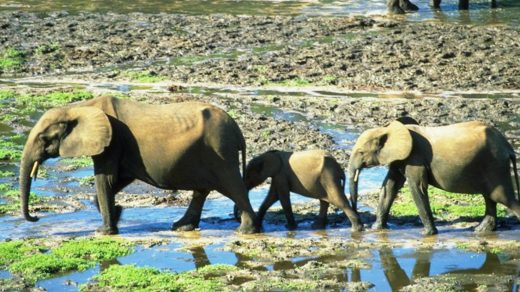
There were immediate and severe consequences. Most notably gorillas, elephants, and antelopes are being lost at dramatically alarming rates. The fate of other species is yet unknown. When the alarm sounded: a horror story of unchecked, protracted poaching and malignant institutional neglect, Gorilla Haven responded. In October 1999 a group of concerned organizations and individuals established an immediate, short-term, "bottom-up" emergency relief effort to be achieved even in the midst of war and turmoil.
Four DRC protected areas (Maiko, Virunga, Okapi Reserve, and Kahuzi-Biega) are most flagrantly exposed to poaching due to their strategic accessibility by surface road infrastructure and proximity within the urban triangle of Bunia-Bukavu-Kisangani (the modern day version of the Bermuda Triangle). One example is the high-profile Kahuzi-Beiga National Park which has had their elephant population reduced from 320 elephants to less than 20 (this number may be far fewer, as they have only detected the tracks of five elephants during recent surveys).
Further, wildlife within the Upemba and Kundulungu National Parks are in jeopardy from the heavy concentration of displaced people fleeing the DRC for the borders of Zambia and Tanzania. The Salonga National Park lies directly in the strategic path along the battle front-line of alternating government/rebel troop occupation. These "protected areas" continue to suffer the ravages of armed conflict. The international unified partnership, which Gorilla Haven joined, established the goal to provide emergency survival and morale supplies directly to the DRC Park Rangers, which we can reach. Our priorities are the certainty of secure delivery of supplies and short-term nature of the mission. Gorilla Haven is in good company. The joint effort is sponsored by concerned individuals and internationally respected organizations, including the International Fund for Animal Welfare, Born Free Foundation, Columbus Zoo of Ohio, Humane Society United States, and Fund for Animals.
The way we work is to purchase specific items and deliver them into the hands of the respective Park Conservateur via our secure contacts. This way we are assured that each dollar spent has arrived to its destination. Our effort is not towards developing an in-country structure or lasting program. We are an emergency on-the-ground response team. We are working in agreement with the Institut Congo pour la Conservation de la Nature (ICCN, the DRC Department of Parks), resident contacts, and local NGOs in-country. This is no easy task and requires careful, deliberate orchestration in a country effectively partitioned and in the throes of war. The Park Rangers are a very experienced and dedicated group of men, committed to their tasks, known to risk their very lives to protect their charges, personally faced with desperate economic circumstances, and the only ones who will ultimately conserve DRC wildlife. By providing a few emergency resources and motivational support, it is our hope to achieve a tangible and meaningful conservation effort.
Please send your checks to Gorilla Haven, P.O. Box 210, Morganton, GA 30560 USA.
Gorilla Haven and our supporters' response to this plea have contributed almost $6,000 to help Dr. Jo Thompson and the Friends of the Lukuru since we first posted this web page in February. Here is an update by Dr. Thompson about how our sponsorship and that of others is helping make a difference
As we experience the rebirth of hope that comes with springtime and evaluate what progress we have made toward the DRC wildlife crisis, we sincerely extend our deepest gratitude to those individuals who have responded either financially or through their actions. Public awareness and outcry is beginning to turn the tide. Our team of sponsor organizations has expanded to include the Dian Fossey Gorilla Fund-Europe, Friends of Washoe and Primate Conservation, Incorporated.
In a few short months the direct contributions from our DRC Parks Relief Mission sponsor organizations and individuals across the globe have enabled us to provide rain gear (ponchos and coats), rubber boots, clothes, blankets, books, soap, 100 backpacks (knapsacks), canteens, five Garmin GPS units, rechargeable batteries, a computer, a color printer, a scanner, computer software, materials to repair Ranger houses, medicines and office supplies directly into the hands of the Kahuzi-Biega National Park Rangers. Sister initiatives for KBNP born from under the umbrella of our Relief Mission include the delivery of a 101 Toyota LandRover for patrolling accessible areas, general transport and heavy-duty haulage of materials; and funding from IPPL (International Primate Protection League), Nouvelles Approaches and Wild Images for the printing of 20,000 copies of "le Gorille 2 - Parc National de Kahuzi-Biega" which is being distributed to the human population in and around the Park. The publication has been translated into English and widely distributed to individuals and organizations whose interests and goals focus on African wildlife conservation.
The widespread action of individuals who wrote letters to American government officials has been successful and I would encourage continued pressure. The US Department of State has generously communicated with our Relief Mission and continues to work in cooperation with our efforts. The encouraging news is that, since the killing of three individuals from the Ganywamulume family (previously composed of 17 members) by poachers between January 10-18, there has been no evidence of gorilla killing in the controlled portion of Kahuzi-Biega National Park. We may further be encouraged by the cautious success of the ceasefire agreement effected on Friday 14 April. Ultimately only peace, security and stability will save the critical wildlife in DRC. Our DRC Parks Relief Mission continues to respond to the emotional and physical needs of the Park Rangers to aide them in monitoring and patrolling. They now know that their efforts are extremely important, that the international community cares and is providing concrete support on their behalf. You are making a vital contribution. Thank you all for your continued response!
September 19, 2000 Update - By Dr. Jo Thompson:
Since my last update further progress has been made for Kahuzi-Biega and on behalf of other DRC Parks. Research activities have returned to Kahuzi-Biega, check points again offer control over materials leaving the Park, and NO GORILLAS HAVE BEEN KILLED since January. A team of government representatives, local authorities, civil employees and local workers had begun working on the manifestation of PNKB limits.
However, on 5 September their camp was attacked by Interahamwe militia. In the course of the skirmish, 11 people died. This has rendered a demoralizing blow to the restored spirits of the PNKB Rangers, but they press on. Two representatives of the DRC Parks Relief Mission, Mr. Michel Hasson and Dr. Jo Thompson, undertook a journey to deliver supplies, draw public attention, determine status and access further needs for Upemba National Park and Kundelungu National Park. These two Parks do not benefit from the support awarded to their DRC sister National Parks, including Kahuzi-Biega, who enjoy the status of World Heritage Site. Therefore, these two critical areas have been largely forgotten by the world and left to suffer the crippling affects of catastrophic poaching pressure and institutional neglect. From 3-24 August 2000, Mr. Malembe-Mbo (President-Delegue General, Institut Congolais pour la Conservation de la Nature, Kinshasa) accompanied the Relief Mission team on visits to three posts: Kundelungu-Katwe Headquarters, Upemba-Kayo SubSector, and Upemba -Lusinga Headquarters.
Materials including 80 tents, 125 bicycles, 89 backpacks, 94 ponchos, 70 pairs of boots, medicines to restock each dispensary, women's and children's clothing, children's toys, school books and materials, scientific literature, information cards on mega-fauna within the Parks and construction materials were delivered to each post and specific needs of a short-wave radio battery for Kayo were provided. An additional two tons of clothes and boots are being prepared for shipment. Communications for monitoring and patrolling wildlife and basic life support services are critical. We propose installing windmill power to the water well of Kundelungu and refurbishing the hydroelectric generator for Upemba. Actions have begun to locate either new or refurbished walkie talkies to be donated for Lusinga. In addition to inspecting the depots of snares and arms confiscated from poachers, we visited and honored the graves of two guards at Post Kayo (PNUpemba-Sud) who were killed, at ages 29 and 59 years, while confronting armed poachers. We were introduced to another guard who had been seriously injured during that same clash. His right shoulder still bears the deep imprint scar of the critical injury he sustained from a poachers bullet.
As the DRC Parks Relief Mission looks ahead, we are preparing to assist Salonga National Park-South Block with specific needs. Further, we will be producing the new national ICCN-Garde de Parc insignia patches to be sewn on Ranger uniform shirts (breast pocket and left upper sleeve) and hats. These are a critical need to distinguish Rangers from military or rebel troops and armed combatants. Most recently we have received direct communications from the Conservateur of Maiko National Park, the third DRC Park without benefit of World Heritage Status. We hope to be able to provide assistance to this critical protected area. You may remember from my first report, Maiko National Park ranks second (after Kahuzi-Beiga) in the numbers of Grauer's gorillas within its boundaries.
With additional funds, we will continue to address the needs of Kahuzi-Biega, Upemba and Kundelungu and respond to the needs of other DRC Parks.
Update - 21 March 2001 - by Dr. Jo Thompson
Six months have passed since my last message. The DRC Parks Relief Mission continues to work diligently in response to the critical needs of wildlife and habitat conservation in DRC. We are succeeding! Our current sponsor organizations include International Fund for Animal Welfare, Columbus Zoo of Ohio, Gorilla Haven, International Primate Protection League, Born Free Foundation, Fund for Animals, Chester Zoo - UK, Dian Fossey Gorilla Fund - Europe, Friends of Washoe, and Primate Conservation Incorporated. During the past months, the DRC Parks Relief Mission began its most ambitious project.
We are producing the new Garde de Parc uniforms for all ICCN personnel across DRC. Inline with the highest priority objectives established by ICCN, we are providing the Garde uniforms (shirt, trousers, hat, ankle-boots, and belt) for 1,200 uniformed ICCN staff. As mentioned previously, we are also producing the new "ICCN Garde de Parc" insignia patches to be worn on the cap, shirt pocket, and a set on the left sleeve of each uniform. With the earliest wave of unrest, in 1997 Park Garde were stripped of their uniforms. These uniforms are a very potent symbol to the national community and give the Rangers their identity, motivation, sense of unity and primary source of professional pride. Working in cooperation with the DRC Minister of Defense, the Garde de Parc uniform identifies them as distinct from all militant and military groups. We have negotiated a contract with a textile manufacturer in Kinshasa (the capital city of DRC). This firm has been unemployed as a result of the war. Through our contract we have been able to offer employment and an economic boost directly into the urban human population of DRC. For the 1,200 Garde, our "Outfit a Ranger" campaign goal is $60,000. The cost of each complete uniform (trouser, shirt, cap, ankle-boots, belt, and four official insignia patches) is $50.
Currently, we are well underway with the shipment of supplies for Salonga National Park - South Sector (PNS-SS. We are providing communications equipment (walkie-talkies and HF radiophonie), tents, backpacks, rain gear, medicines, machetes and equipment to clear patrol routes, bales of civilian clothes for women, children, and men … and more. This is the only nationally recognized protected area within the range of bonobos. The discontinuous and widely scattered occupancy of bonobos within a very confined area is bisected by the frontline of adversarial occupied zones of conflict. Our support will be a critical message to the staff of PNS-SS! We have successfully produced 20,000 issues each of #2 and #3 "le Gorille - Parc National de Kahuzi-Biega" and are in the process of distributing "le Gorille #4."
For your continued efforts in our letter-writing campaign, I have updated the letter-writing contact information to reflect changes in the US government administration effective 21 January 2001. The commitment and active involvement of Institut Congolais pour la Conservation de la Nature (ICCN), the DRC government branch responsible for nature conservation, is pivotal to accomplishing something important for the environment. The withdrawal/disengagement of foreign forces on DRC soil is "scheduled" for completion by May 15th. Thus, the inter-Congolese dialogue is our next serious avenue to promote conservation issues through the strong commitment of the Security Council. Conservation and the environment must be on the agenda during the reintegration and resettlement of the people in DRC and the reconstruction and development of the country. We can only achieve this by focusing the attention of the Security Council on the environment.
The permanent protection of the critical DRC faunal and floral biodiversity can only be ensured through the leadership of ICCN. Thus, the Lukuru Wildlife Research Project has organized a mission with the top DRC representatives of ICCN to meet with officials of the United Nations towards igniting a powerful conservation movement using DRC as the icon.
Dr. Jo Thompson, Director
Lukuru Wildlife Research Project

Although our web page has only been recently put up, many people have asked where they should write or how they can help. Here are some ideas. You may want to write about how our government can exert influence through economic policy and trade.
To UK allies: For individuals interested in tapping into
"political will" (we have had
great success in our US letter writing campaign) and its
resounding powers on
behalf of all three African great apes, please write to:
Sir Jeremy Greenstock
UK Mission to the United Nations
1 Dag Hammarskjold Plaza
28th Floor
885 2nd Avenue
New York, NY
USA 10017
Ambassador Nancy Powell, Acting Assistant Secretary of State
Department of State, Bureau of African Affairs
2201 "C" Street, NW
Washington, D.C. 20520 USA
tel: (202) 647-4440
fax: (202) 647-6301
H.E. Mr. James B. Cunningham
U.S. Mission to the United Nations
799 United Nations Plaza
New York, NY 10017-3505
tel: (212) 415-4000
fax: (212) 415-4443
Representative Edward R. Royce, Chairman
Africa Region, Subcommittee on International Relations
1133 Longworth, House Office Building
Washington, D.C. 20515 USA
tel: (202) 225-4111
fax: (202) 226-0335
Representative Henry Hyde, Chairman
Committee on International Relations
2110 Rayburn, House Office Building
Washington, D.C. 20515-1315 USA
tel: (202) 225-4561
fax: (202) 225-1166
Representative Jim Kolbe, Chairman
Subcommittee on Foreign Operations, Export Financing and Related Programs
2266 Rayburn, House Office Building
Washington, D.C. 20515-0305 USA
tel: (202) 225-2542
fax: (202) 225-0378
Senator Orrin Hatch, Chairman
Subcommittee on International Trade
104 Hart Senate Office Building
Washington, D.C. 20510 U.S.A.
tel: (202) 224-5251
fax: (202) 224-6331
Senator Jesse Helms, Chairman
Committee on Foreign Relations
403 Dirksen Senate Office Building
Washington, D.C. 20510-3301 U.S.A.
tel: (202) 224-6342
fax: (202) 228-1339
Senator Bob Smith, Chairman
Committee on Environment and Public Works
G50 Dirksen Senate Office Building
Washington, D.C. 20510 U.S.A.
tel: (202) 224-2841
fax: (202) 224-1353
You can further investigate U.S. senators from your state by
going on-line to: http://www.senate.gov/senators/index.cfm
In addition to these executive and legislative branch
individuals, if you (or anyone else) want to write to your
specific state representative, check on-line at: http://www.house.gov/writerep/
THANKS for your
concern and action!